
Seven Takeaways from Warsh Confirmation Hearing
Dr. Jeffrey Roach | Chief Economist
Last Updated: April 22, 2026
Kevin Warsh's bid to become the next chair of the Federal Open Market Committee (FOMC) unfolded amid sharp political tension, legal uncertainty, and pointed questions about his independence from President Trump. During a combative Senate confirmation hearing, Warsh sought to reassure lawmakers that he would not allow political pressure to dictate monetary policy, even as unresolved Justice Department investigation into current Chair Jerome Powell threatens to delay his confirmation and underscores broader concerns about the politicization of the central bank.
Kevin Warsh’s confirmation hearing comes at a moment when U.S. monetary policy is already notably restrictive relative to most other advanced economies, sharpening the political and market sensitivity around the Federal Reserve’s (Fed) next steps.
U.S. Policy Rate Highest Among the G-7
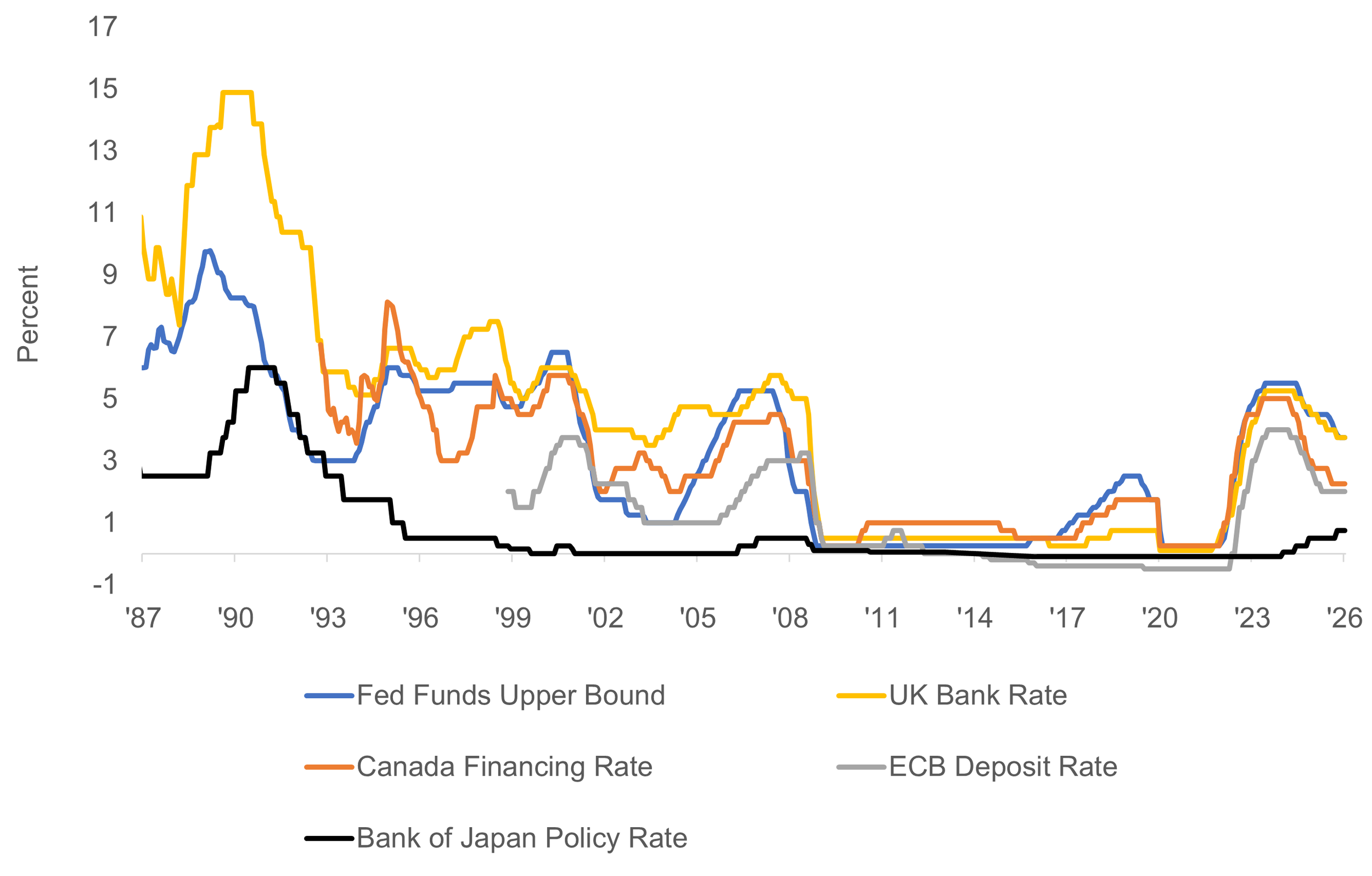
Source: LPL Research, Bank of Canada, Bank of England, Bank of Japan, European Central Bank, Federal Reserve Board, 04/22/26
As of April 21, 2026, the Fed’s target range for the federal funds rate stands at 3.50% to 3.75%, well above policy rates at many peer central banks, including the European Central Bank’s 2.15% policy rate, the Bank of England’s 3.75% Bank Rate, the Bank of Canada’s 2.25% overnight rate, and the Bank of Japan’s 0.75% policy rate. That gap has become central to the political debate surrounding Warsh’s nomination, with President Trump arguing that U.S. rates should be “the lowest in the world,” even as global counterparts face different inflation dynamics, energy shocks tied to Middle East tensions, and divergent growth outlooks. Against this backdrop, lawmakers used the hearing to test whether Warsh would prioritize narrowing the international rate divergence through faster U.S. easing — or adhere to the Fed’s traditionally data-driven approach despite mounting external and political pressure.
Here are 7 Key Takeaways
1. Warsh Emphasizes Fed Independence
Warsh repeatedly stated that he would not cut interest rates at President Trump’s behest, insisting that Trump never asked him to pre-commit to any specific policy actions and pledging to remain “strictly independent” if confirmed.
2. Political Pressure on the Fed Is Intensifying
Lawmakers highlighted that Trump’s actions have gone beyond rhetoric, including an effort to remove Fed Governor Lisa Cook and a Department of Justice (DOJ) investigation into Powell, both of which have raised alarms about threats to institutional independence.
3. DOJ Investigation Could Delay Confirmation
A criminal investigation into Powell’s handling of the Fed’s headquarters renovation has become a procedural roadblock, as Senator Thom Tillis has vowed to block Warsh’s confirmation until the probe is resolved.
4. Powell Could Remain Chair Temporarily
If Warsh is not confirmed by May 15, Powell has said he would continue serving as chair on an interim basis, adding uncertainty to the Fed’s leadership at a sensitive time for monetary policy.
5. Scrutiny of Warsh’s Shift on Inflation and Rates
Democrats pressed Warsh on his evolution from an inflation hawk during his previous tenure at the Fed to a recent advocate for rate cuts, a shift he justified by pointing to balance sheet reduction and potential productivity gains from artificial intelligence.
6. Criticism of Fed Policy Framework and Communication
Warsh argued that persistent inflation overshoots reflect Fed policy errors during 2021–2022 and called for “regime change,” including a new inflation framework and less forward guidance such as scaling back the Fed’s “dot plot.”
7. Personal Wealth and Financial Conflicts Raised Concerns
Senators, particularly Elizabeth Warren, questioned Warsh about his substantial personal wealth and opaque investment holdings. Warsh pledged to divest all financial assets and move to “plain vanilla” investments if confirmed.
Bottom Line
Warsh’s confirmation hearing underscored how deeply debates over Fed independence, inflation credibility, and political influence have become entangled. Even as he sought to project autonomy and a reform-oriented vision for monetary policy, unresolved legal investigations and partisan tensions threaten to delay his path to confirmation. The outcome may not only determine Warsh’s future but also shape how markets and the public perceive the Fed’s ability to operate independently in an increasingly politicized environment. As it relates to interest rate expectations, the hearing strengthens the view that Warsh may tighten conditions via balance sheet normalization while simultaneously loosening conditions by lowering interest rates. These actions may not occur until much later this year as conditions warrant.